Finding a Way Together: A Story of Care in Ajmer
Finding a Way Together: A Story of Care in Ajmer
Denied for 3 Years. Now Helping Others Access Their Rights
In the winding lanes of Khanpura, Ajmer, Shanno’s home stood as a place of contrasts—two stories unfolding under one roof.
To an outsider, the building looked “large”—big enough to disqualify her from receiving basic food rations. But inside, the reality was stark: six families, including Shanno and her two sons, were crammed into a single structure.
For three long years, this gap between perception and reality kept a widowed domestic worker struggling to feed her children.
“I felt like I was shouting into a void,” Shanno says. “I would go to the offices, fill forms, and wait. But nothing happened. I started to feel that people like me are meant to be forgotten.”

Turning Point
The change came not through another application, but through connection.
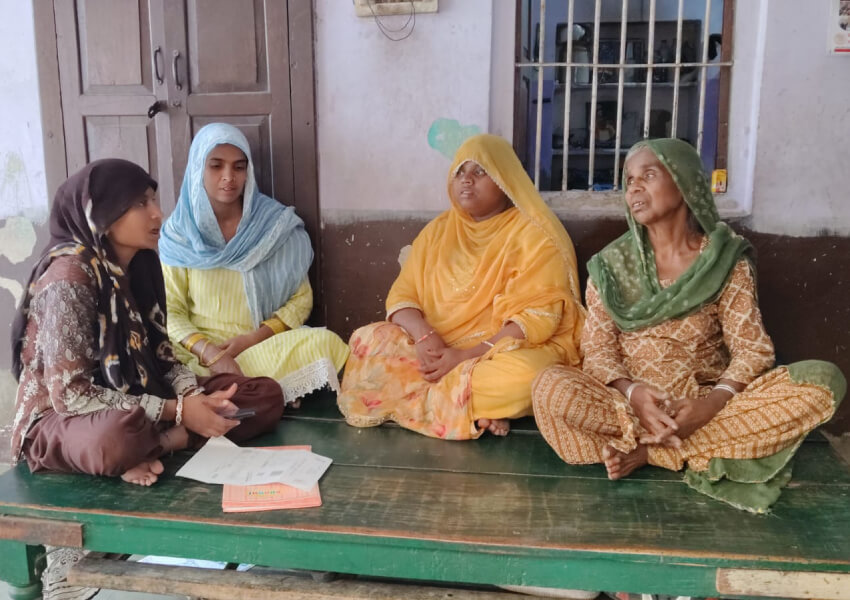
That connection began at a social security camp organized by CFAR’s Single Window team, a community-based platform that helps people access government entitlements and resolve service gaps, at a local madrasa. At the camp, Shanno found people willing to listen and help. The team not only processed her case but also bridged the gap between her lived reality and the system’s assumptions. They verified her situation, advocated on her behalf, and ensured her voice was finally heard.
Sultana, a Single Window member, vividly recalls her first meeting with Shanno:
“When I met Shanno, I saw a woman exhausted but still holding on. On paper, it was a ‘large house.’ But when we visited, we saw six families sharing one space. My role wasn’t just to file a report; it was to make sure her reality reached the right people. When she finally received her first ration after three years, it wasn’t just a delivery—it was a moment that reaffirmed why this work matters.”

A New Future for the Family
The support didn’t stop at food. Once the door was open, the team helped Shanno access the Palanhar scheme—a program specifically designed to support the education and care of children who have lost a parent. With this steady support, Shanno’s two sons are now enrolled in school, trading a life of uncertainty for a seat in a classroom.

From Seeking Help to Becoming a Champion
But the story doesn’t end there. Shanno didn’t just reclaim her entitlements, she transformed her experience into purpose.
Knowing that many others face the same barriers, she became a “Champion” at the neighbourhood help desk. Each afternoon, she now supports multiple women in her neighbourhood—helping them navigate digital platforms, understand government processes, and organise their documents.

The Ripple Effect
Shanno’s impact is now felt across the heart of her settlement. In Khanpura, a neighbourhood of 150 vulnerable households, she has become a vital anchor for her neighbours. Since becoming a Champion, she has already personally supported 25 families on their journey toward social inclusion—ensuring that others in her community can access their rights and essential support within weeks, rather than the three years of silence she once endured.
One of the many people she has supported is Suwa Bai, her neighbour, who was struggling to access her widow’s pension.
“I was afraid of offices and complicated processes,” Suwa Bai says. “But Shanno sat with me at my doorstep and said, ‘If I can do it, so can you.’ She didn’t just share information; she gave me confidence. Because of her, my children now have what they need.”

Shanno’s journey shows what a “caring neighbourhood” truly means. It goes beyond schemes and systems—it lives in everyday acts of solidarity. In neighbours who step forward, who listen, and who refuse to let others remain unseen.
As Shanno says, with a quiet smile:
“I used to feel invisible. Now, when someone stops me on the street to ask for help with a form, I feel like I finally belong.”
Stories like Shanno’s reflect CFAR’s belief that when communities lead and systems respond, dignity becomes possible. Strengthening such community-led platforms is at the heart of building more caring and inclusive neighbourhoods.